A Marketer's Workday: How to Plan One That Survives the First Email
You plan the perfect day in the morning, and after the first email it's all different. Sound familiar? At the first Marketing Chatter, we talked with other marketers about how they work, how they get themselves to write and what they do about deadlines. We wrote down the parts you can use right away.
TL;DR
- A marketer's workday is a mix of focused creative work, learning and small tasks. If you don't split it into blocks, emails and other people's priorities will take it apart.
- Motivation comes from small steps and small rewards, not willpower. Break big tasks down and set deadlines that push you without crushing you.
- Plan your learning and your time off in advance. Otherwise learning slides into your evenings and work spills into the weekend.
What does a marketer’s workday look like?
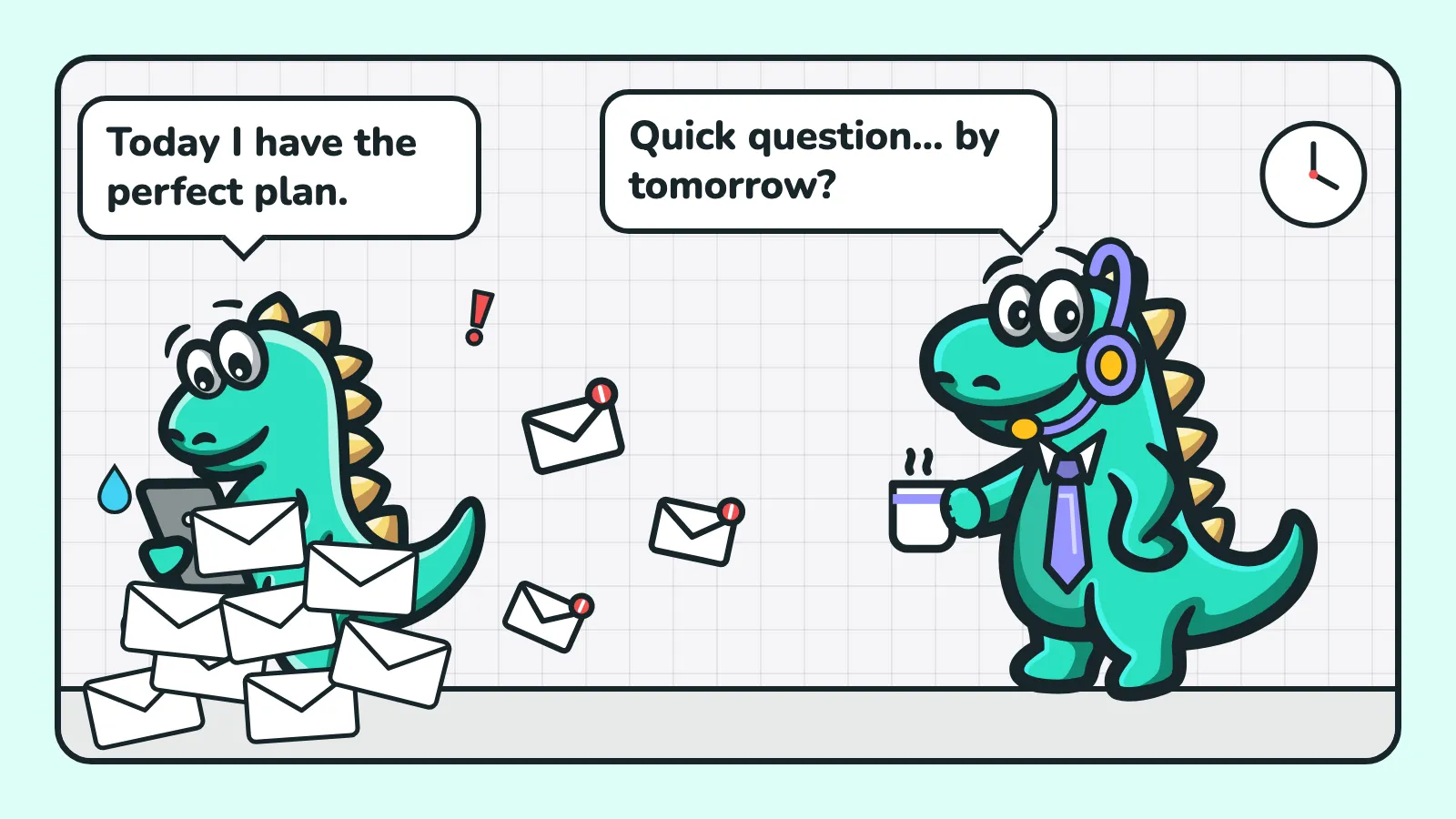
A marketer’s workday comes in 2 versions: the one you plan in the morning and the one that actually happens. It came up right at the start of the first Marketing Chatter: the perfect plan often falls apart minutes after you open the first email.
The group was a mix of copywriters and content marketers from in-house teams, agencies and freelancing. We covered the workspace, tools, routines, motivation, learning, deadlines and weekends. Below is what worked for people and what didn’t.
What workspace and tools does a marketer need?
Some people write in an open-plan office, others at the kitchen table. The place varies, the setup not so much: a monitor with the content plan, a calendar, a notebook and social media open in a tab. That last one is a work tool and the best way to procrastinate at the same time. According to the Chatter, there’s 1 more essential: a secret snack drawer.
A content marketer’s typical digital toolkit:
- Website management: a content management system, most often WordPress.
- SEO: tools for keywords and competitor research, like Semrush or Ahrefs.
- Measurement: Google Analytics, to see how content performs.
- Design: quick visuals, usually in Canva.
- Planning and approvals: one place that shows what’s coming up, who’s working on what and what’s waiting for approval.
You don’t need many tools, but the whole team has to know where everything lives. Otherwise you spend half the day digging through your inbox for the latest version of a text.
How do you split the day between creating, learning and small tasks?
A marketer’s day is made of 3 kinds of work: focused creative work, learning and small tasks like emails, comments and meetings. If you let them mix freely, small tasks win every time. So split your day into blocks.
What works:
- Creative mornings, analytical afternoons: write while your head is fresh, leave numbers and admin for after lunch.
- Batched email: check it 2–3 times a day instead of watching it all day.
- One to-do list: on paper or in an app, as long as it’s 1 and not 5 in different places.
- Movement between blocks: when you’re stuck, a short walk helps more than another coffee.
Example: a freelance copywriter’s day
- 9:00–9:30: emails and agreeing on deadlines.
- 9:30–12:00: the hardest piece of writing of the day, notifications off.
- 13:00–14:30: proofreading, edits based on feedback, planning.
- 14:30–15:00: a walk.
- 15:00–16:30: reporting, second email check, prep for tomorrow.
You don’t have to stick to it to the minute. It’s enough that your hardest task has protected time that nothing else gets into.
How do you get yourself to write?
Motivation comes and goes, and working from home it’s sometimes hard just to start. People at the Chatter shared 4 tricks that work for them:
- Carrot and stick: a chocolate bar after finishing a chapter, or no chocolate until the text is sent.
- Chunking: split a big task into small steps, like the outline, the first paragraph, the subheadings.
- Deadline as a whip: some people work best under the pressure of a due date.
- Purpose: remind yourself why the work matters and who the text will help.
Chunking with a small reward is the most reliable combination. Willpower runs out before the chocolate does.
Sometimes the problem isn’t laziness but an empty head. Then podcasts, webinars, communities or competitors’ content can help. For specific tips on where to find ideas, see our list of marketing inspiration sources.
When and how do marketers keep learning?
The field changes fast and learning never stops. But at the Chatter it turned out that many people treat learning more as a free-time activity than as work. A podcast plays while they cook, articles get read in the evening.
The opposite works better:
- Book time in advance: a specific calendar block for a specific course or topic.
- Learn from what you’re working on: when you write about something new, the research is learning too.
- Keep podcasts for downtime: as a bonus, not as the only way to keep up.
How do you handle deadlines?
Content deadlines are strict, and there are often several running at once. What matters is telling which task is big and important, and which one is just loud.
2 takeaways from the Chatter are worth keeping:
- Don’t say “tomorrow” on autopilot: the first date that comes to mind is usually too optimistic. Take a moment and send one you can actually meet.
- Don’t create deadlines nobody asked for: a lot of stress comes from due dates marketers set for themselves, even when the client isn’t pushing at all.
It helps to have all deadlines in 1 place. In Contesaur, the content calendar shows what goes out when, and you send finished pieces for approval right there. No more chasing feedback through email.
Do marketers work on weekends?
Sometimes. Most try to avoid it by planning content ahead and setting boundaries. But even the best plan can’t cover everything. A post triggers a flood of negative comments, a client suddenly needs more attention, or something happens in the world that you need to react to quickly.
The Chatter came up with a simple rule: if you don’t get the work done during the week, it spills into the weekend. Leaving slack in your weekly plan costs less than a Saturday at the laptop.
Common mistakes
- A perfect plan with no buffer: a day planned at 100% falls apart with the first unplanned thing.
- “Tomorrow” on autopilot: you promise speed you then have to make up in the evening.
- Deadlines nobody asked for: extra pressure for no reason.
- Learning only in your free time: it drags into your evenings and you’re too tired for it anyway.
- Living in your inbox: you react to everything and there’s no time left for the most important task.
Quick check for tomorrow
- Hardest task: does it have a protected block?
- Email: do you know when you’ll check it?
- Buffer: is there at least 1 free slot for the unexpected?
- Deadlines: are the ones you’re promising realistic?
Wrap-up
A marketer’s workday doesn’t have to be chaos. Split it into blocks and protect your hardest task. Promise deadlines with a buffer. The plan will still fall apart now and then, but you’ll have the pieces to put it back together. And if all else fails, there’s always that snack drawer, good enough to tempt a T-Rex.
Marketing Chatter is a free online meetup held in Czech. See the upcoming dates.
FAQ
How many hours a day does a copywriter actually write?
Usually fewer than they'd expect. Communication, research, proofreading and admin eat up a big part of the day, so it pays to protect at least 1 block of focused writing every day.
Is it better to work from home or from the office?
It depends on what distracts you more. Home is quieter for writing, but it's harder to get going and work blurs into free time. The office brings more input and more interruptions, so you have to guard your focus time there.
How do you tell a client you'll miss a deadline?
As early as possible, and with a specific new date. Clients take a delay better than a surprise on the due date, especially when they know right away when the work will arrive.
How do you separate work and personal life as a freelancer?
A fixed end to the workday helps, along with a dedicated workspace and work notifications switched off after hours. Tell clients upfront when they can reach you.