Marketing Inspiration Sources: Newsletters, Podcasts, People and Events
Good sources of inspiration are hard to find, because most marketing education is either too theoretical or self-promotion in disguise. At the second Marketing Chatter, we asked other marketers who they follow and where they get their ideas. We went through their tips and updated them.
TL;DR
- A marketing inspiration source is a newsletter, podcast, person or event that gives you a method you can use in practice, not just general advice.
- Specific people and tools give you the most: newsletters by practitioners, experts on LinkedIn, courses built on a clear method and meeting other marketers.
- Fewer sources, read regularly: pick a handful, book time for them and take 1 thing from each that you'll try out.
Why are good marketing inspiration sources so hard to find?
At the second Marketing Chatter, we talked about marketing inspiration sources. Where we go for news, who we follow and where we look for ideas when we run out. Right at the start, we all had the same complaint: most marketing education is either too theoretical or self-promotion in disguise.
The sources that give you the most are the ones with a specific method or framework you can put to work right away. In a small market like the Czech one, those are hard to find. Still, we put together quite a few.
This isn’t a complete database, just the tips shared at the Chatter. Before moving the list to our new website, we checked every link and removed the ones that no longer exist. The Chatter is held in Czech, so many sources are Czech too, they’re marked “in Czech”. Missing something? Let us know.
How do you recognize a good source of inspiration?
- A specific method: after reading it, you know what to do differently tomorrow.
- Practice over theory: the author actually does the work, not just talks about it.
- Free advice first, selling later: the source gives you value even if you never buy anything.
- Regularity: it comes out often enough to stay on your radar, and not so often you can’t keep up.
Who should you follow on LinkedIn?
On LinkedIn, practitioners share the most specific insights from their own work. These are Czech marketers who mostly post in Czech.
- Bára Hlavicová: copywriting, naming and brand voice.
- Martin Klusoň: Kroupahelán.
- Marek Vlček: branding and UX/UI design.
- Pavel Jartym: SEO and editing website copy.
- Jan Junek: web designer and consultant, user experience (in Czech).
Which marketing newsletters should you subscribe to?
A newsletter is the most convenient source of inspiration. It comes to you, and you read it when it suits you.
In English:
- UX Content Collective: UX writing and content design.
- Science Says: science-based marketing insights (formerly Ariyh).
- Gartner for Marketers: trends and research for marketing leaders.
- Please Advise: a newsletter for marketers.
- Jonathan Stark: how consultants and freelancers can stop selling their hours.
- Behavior Gap: Carl Richards and his simple sketches about money, creativity and decision-making.
In Czech:
- Zápisky z terénu: the newsletter of Hook & Tell (formerly Obsahová agentura), an agency focused on copywriting and content marketing.
- Newslettery: Martin Kavka on email marketing.
- House of Řezáč: Jan Řezáč on strategy, AI and websites.
- Na volné noze: for everyone who works freelance.
- Ilinčev: UX, design and user psychology.
- Otto Bohuš: copywriting and working with text.
- B_orNot_2B Copy Digest: a copywriting digest by Eva Žáčková. The latest issue is from May 2025, but the archive is worth a look.
Which podcasts and videos are worth your time?
- The Brainy Business: behavioral economics in marketing and sales.
- Zeptej se Filipa: Filip Novák on YouTube about marketing and repeat sales (in Czech).
- Mad Men: a TV series set in an advertising agency. It’s not a manual, but you’ll learn a lot from it about clients and ideas.
Which books and magazines should you read?
- Damn Good Advice (For People with Talent!): advice from advertising legend George Lois.
- Don’t Make Me Think: Steve Krug on web usability.
- Jak na sítě: a book on social media by Michelle Losekoot and Eliška Vyhnánková (in Czech).
- Marketing & Media: a Czech marketing trade magazine (in Czech).
Which conferences and events should you attend?
At events you meet people you can talk ideas through with on the spot. No newsletter gives you that.
- Marketing Chatter: an online discussion among marketers where everyone gets a say (in Czech).
- Marketing Festival: a marketing conference in Brno, next edition in April 2027.
- Czech Online Expo: a digital marketing event (in Czech).
- B2B konference: an event focused on B2B (in Czech).
- Web Summit: a large international tech conference.
Which courses are worth taking?
- Mini MBA: Mark Ritson’s online marketing course.
- Škola mistrů textu: Otto Bohuš’s long-term copywriting training program (in Czech).
- Lenka Stawarczyk: training on tone of voice and writing with AI (in Czech). For a practical take on tone of voice, see our Marketing Chatter recap on tone of voice.
- Digisemestr: 12 weeks of online marketing education (in Czech).
Other websites and tools
- HubSpot: blog and templates.
- Pipedrive: courses and resources on sales.
- Semrush: resources and statistics on SEO and content.
- Buffer: a blog about social media.
- Kaye Putnam: psychology-driven brand strategy.
- Mention: a tool for monitoring brand mentions.
- Content Studio AI: a tool that turns text into videos with AI.
- Frameworks and mind maps: design thinking or brand archetypes help you sort and develop ideas.
How do you turn inspiration into a system?
Reading a newsletter doesn’t change anything by itself. Inspiration only helps once it turns into actual content.
- Pick a handful of sources: 3–5 newsletters and a few people are enough. Unsubscribe from the rest.
- Book time for them: for example 1 block a week. For more on structuring your week, see our article on a marketer’s workday.
- Take 1 thing from each source to try out: for example, test an insight from Science Says about how people react to prices in your next newsletter.
Once your ideas turn into a plan, you can lay it out in the content calendar in Contesaur. The AI marketing manager then suggests more topics based on your brand and personas.
Common mistakes
- Subscribing to everything: unread newsletters only add guilt.
- Reading only self-promotion: a source that never gives you anything for free won’t teach you anything.
- Only local, or only English-language sources: you miss either the trends or the local market.
- Only consuming: ideas you don’t write down and try out are gone within a week.
Wrap-up
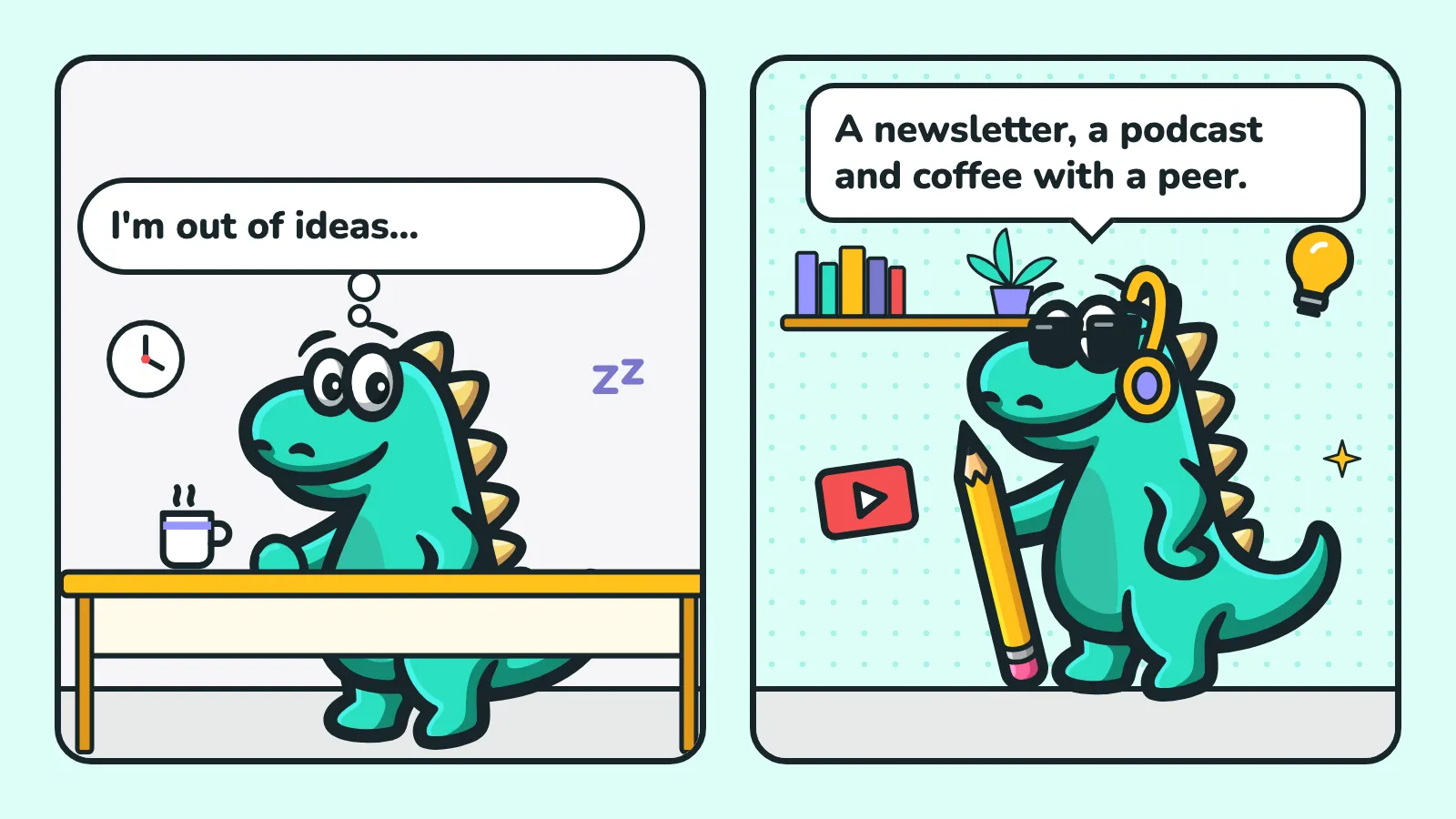
There’s no shortage of good inspiration sources, they’re just scattered. Pick a few, read them regularly and take 1 thing from each into practice. And talk to people from other companies and fields. The best idea often doesn’t come from a newsletter but from coffee with someone who does something completely different. Even dinosaurs supposedly hunted better in packs.
Marketing Chatter is a free online meetup held in Czech. See the upcoming dates.
FAQ
How many newsletters should you subscribe to?
As many as you actually read. If unread issues pile up in your inbox, unsubscribe from the ones that gave you nothing in the past month.
Are English-language sources better than local ones?
English-language sources are often ahead on trends and research, local ones know the market, the language and the customers. Reading both works best.
How can you tell a source is just disguised advertising?
If every issue ends with the same offer and you only get the method after you buy, it's mainly a sales channel. A good source gives you usable advice for free and offers a product only after that.
Where can you find inspiration for a specific ad or website?
Search for “best ads” or “best websites” with the current year and go through the winners of advertising and web design awards. It's worth looking outside your own industry too.