AI Copywriting: What to Use AI for When Writing, and What It Won’t Do for You
Will artificial intelligence take copywriters’ jobs, or make them easier? At the third Marketing Chatter, we talked about which text generation tools people were trying, what they used them for and whether we should be afraid of them. The discussion took place in the early days of ChatGPT. The tools have changed since then, but the conclusions still hold.
TL;DR
- AI copywriting means writing copy with the help of artificial intelligence: AI drafts a first version, an outline, variations or synonyms, and the copywriter brings the strategy, the context and the final shape.
- The output is only as good as the prompt: talk to AI like you would to an intern. The more context you give about the company, the audience and the goal of the text, the better the result.
- Google doesn’t penalize AI content for how it was made: what counts is whether it’s helpful to readers. You stay responsible for the facts and the tone.
Will AI replace copywriters?
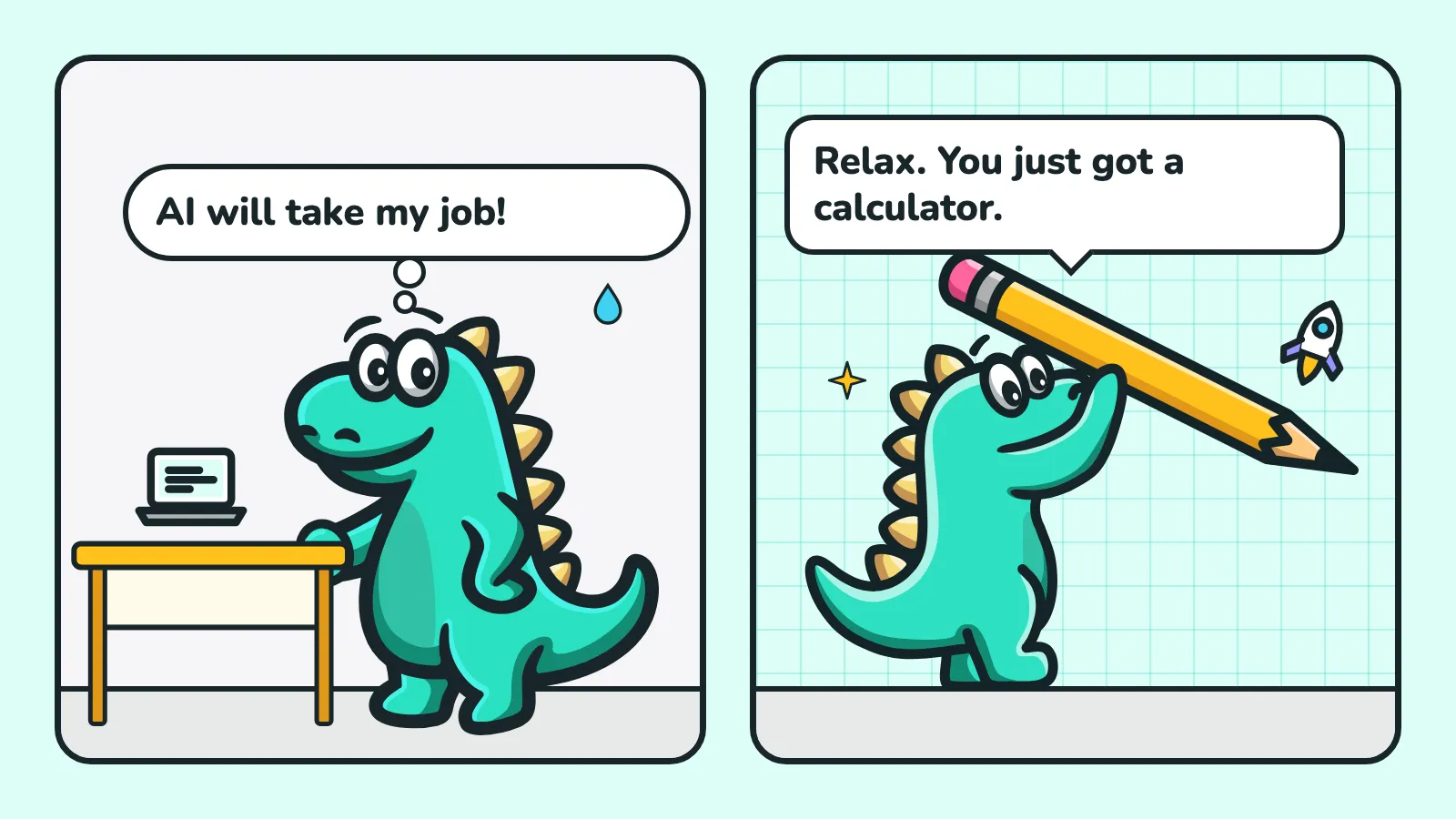
AI copywriting means writing copy with the help of artificial intelligence: the tool suggests a first draft, an outline or variations, and the copywriter turns them into a finished text. At the Chatter, we agreed that machines won’t take our jobs, they’ll change them. The best line of the whole discussion was:
“Copywriters finally got their calculator.”
AI takes away the routine, but leaves the strategy, the context and the responsibility for the text with you. History has shown this many times:
- Photographers survived digital cameras and phones with good lenses.
- Translators coped with machine translation. Even after DeepL came out, clients kept ordering translations.
One participant admitted, though, that she was glad she had entered the field before AI arrived: “ChatGPT can do what I could do as a beginner.” Junior work like writing 7 versions of a product description really is changing. Copywriters are moving towards the parts they enjoy more: thinking about the customer, strategy and fine-tuning the tone.
What should you use AI for when writing?
The biggest benefit is that you no longer stare at a blank page. A junior can generate a first draft to build on. A senior is more likely to use AI for brainstorming, an outline or synonyms.
Participants at the Chatter used AI like this:
- Blog topics: brainstorming lists of topics for clients.
- English copy: campaigns on crowdfunding platforms.
- Explaining a company: how to describe what a company does and which problem it solves for customers.
- Strategy inspiration: ideas on whom to target and how.
- Keywords: translating English keywords into Czech.
- An extended thesaurus: synonyms and variations while fine-tuning the tone.
How do you write a good prompt for AI?
Talk to AI like you would to an intern. The more precise your instructions and context, the better the output. Everyone at the Chatter who used AI daily agreed on that.
One participant described a prompt that surprised her with how well it worked: “I’m the CEO of company X. Find out more about us. I’m dealing with this problem, solve it for me.” The answer showed her what the company’s customers struggle with and how to reach them.
A good prompt includes:
- Who you are and who you write for: the company, the product, the audience.
- The goal of the text: what the reader should do or understand.
- Format and length: an e-mail, a post, an article, a word count.
- Tone: formal or casual, ideally with a sample text you like.
At the Chatter in 2023, people recommended writing prompts in English even for Czech copy. Today’s language models handle other languages far better, so write in the language the result should come out in.
Does Google penalize AI-generated content?
Not for how it was made. In its guidance on AI-generated content from February 2023, Google says it rewards quality and helpful content, however it is produced. Content made mainly to manipulate search rankings is what gets penalized, whether a person or a machine wrote it.
In practice, an AI text that just repeats generic advice won’t get far. A text with first-hand experience, concrete examples and verified facts will. And those are the parts you add.
What has changed since the Chatter, and what still holds?
At the Chatter in 2023, we talked about ChatGPT, Copy.ai, Jasper and the chat in Bing. One participant had been pushing AI in their team since late 2021, another was testing Notion AI. The tools have been replaced several times since then, the principles have stayed:
- Context decides: an AI that knows nothing about you writes generic copy.
- Editing is a must: a person always checks the facts, the numbers and the tone.
- AI speeds you up, it doesn’t think for you: deciding what to write and why is still your job.
Keep your brand context in 1 place so you don’t have to repeat it in every prompt. In Contesaur, the Company section holds your brand, tone of voice, personas and products, and the AI marketing manager uses them to suggest what content to create. To define your tone of voice, read our article on tone of voice.
How do you put AI copywriting into practice?
- Start with the brief, not the text: before AI writes the first sentence, be clear on the goal, the audience and the tone.
- Treat the first version as a draft: rewrite generic sentences, add your own examples and cut what isn’t needed.
- Verify everything you claim: numbers, sources and feature names. AI can make things up convincingly.
Most common mistakes when writing with AI
- A one-line prompt: without context, you get a text that could be about anyone.
- Publishing without editing: generic phrases and errors that readers notice.
- Unverified numbers: a statistic AI made up undermines your credibility.
- Sensitive data in a free tool: client information doesn’t belong in public tools.
- AI instead of strategy: a tool writes the text, but it won’t tell you whether you should write it at all.
Wrap-up
AI didn’t wipe out copywriters, it gave them a calculator. Those who know how to use it write faster and have more time for what a machine can’t do: thinking about the customer. Those who fear it risk ending up like the dinosaurs. They didn’t expect the world to change so fast either.
Marketing Chatter is a free online meetup held in Czech. See the upcoming dates.
FAQ
Which AI tool is best for writing copy?
The one you know how to work with and that handles the language you write in. Large language models such as ChatGPT, Claude or Gemini all write well today. The prompt and your editing matter more than the tool.
Can readers tell a text was written by AI?
Often, yes, mostly from generic phrases, repetitive structures and a lack of concrete examples. That’s why you should edit every AI draft, add your own experience and sourced numbers, and rewrite sentences that could appear in any other article.
Can I put company data into an AI tool?
Only if the tool’s terms and your company’s rules allow it. Free versions may use your data to train the model, so keep sensitive client information and internal numbers out of them.