Sales Funnel: What Content to Create for Each Stage and How to Work Backwards
Customers won’t just fall into your arms. You have to guide them, step by step and without pushing. At the twelfth Marketing Chatter, we looked at how the sales funnel connects to content. What to tell whom and when, and how to work out how many people you need at the top so that someone actually pays at the bottom.
TL;DR
- A sales funnel is a model of the customer’s path from first contact through the decision to the purchase and the care that follows. Some people drop off at every step, which is why it narrows.
- See–Think–Do–Care tells you what content to create, the sales funnel tells you how many people you need at each step. Start with conversion, then cover See and Think in a lean way, and leave Care until you have customers.
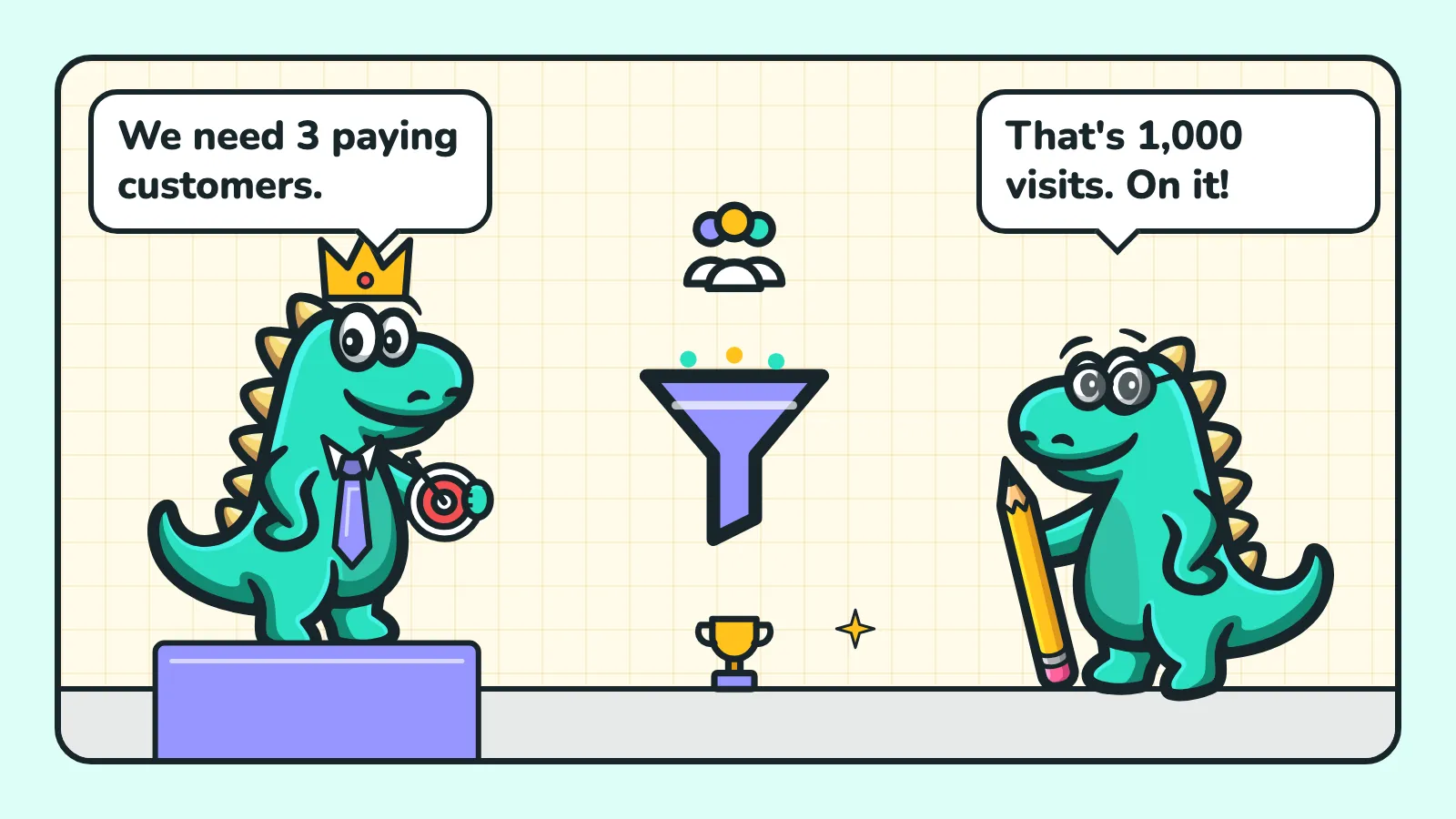
- Build your funnel backwards: from the goal, such as 3 licenses sold per month, through the conversion rate between steps, to the number of visits you need at the top.
What is a sales funnel?
A sales funnel is a model of the customer’s path from first contact through the decision to the purchase and the care that follows. The funnel narrows because some people drop off at every step. Your job is to bring enough people in at the top and lose as few as possible on the way down.
Before you build a funnel, map out your customer journey: the concrete steps a person takes from knowing nothing about you, through a first low-commitment conversion, all the way to paying. The funnel falls out of that path.
How is a sales funnel different from See–Think–Do–Care?
At the Chatter, almost everyone leaned towards the See–Think–Do–Care (STDC) framework. It ties stages to content types and channels nicely, and marketing can set it up even without the sales team.
STDC tells you what content to create. The sales funnel tells you how many people you need at each step. For fast-moving goods like shoes or cosmetics, STDC often does the job. In software, though, “Do” breaks down into several steps, each with its own conversion rate:
- Awareness: someone hears about you
- Lead: they leave their email
- Demo or free sign-up: they try the product
- Paid license: they pay
- Renewal or upsell: they stay and buy more
Signing up for a waitlist or a newsletter is a soft conversion. Payment is the hard one, and in between, people drop off.
What content should you create for each stage?
| Stage | What the person is dealing with | What content to give them |
|---|---|---|
| See | They don’t know you yet. | short posts and videos, banners with a clear message, ads |
| Think | They’re weighing and comparing options. | educational articles, comparisons, buying guides, podcasts, checklists, webinars |
| Do | They’re deciding. | case studies, testimonials, comparison tables, demo videos, free trials, order forms |
| Care | They’ve already bought. | onboarding emails, tutorials, newsletters, customer stories |
In the Think stage, show how things work with you so people can compare you with the competition. In B2B, “Do” usually doesn’t mean “buy now”. It means “leave us your contact”, because a sales conversation comes next. For help picking the right format, see our article on content formats.
So that no stage slips through the cracks, keep them where you plan your content. In Contesaur, See–Think–Do–Care lives in the Company section along with your personas and products. The AI marketing manager builds on them when it suggests content, and you can filter the calendar by stage.
Where do you start when you can’t cover everything?
For startups and small businesses, the Chatter had clear advice:
- Start with Do: once you’ve worked hard to get someone there, buying or leaving a contact has to be easy. A well-tuned conversion page comes first.
- Cover See and Think in a lean way: better a little of both than one of them in full. For example, 1 social network or performance ads, plus a few articles or a webinar.
- Leave Care until you have customers: until someone buys, there’s nobody to take care of.
Without the Think stage, there’s no bridge between attention and purchase. You catch people’s interest, but they leave because they can’t find out how you’d help them and what makes you different. You don’t need a weekly blog. Ask an SEO specialist which first 7 articles to write, and Think is covered.
How do you build a sales funnel backwards?
Most companies start with the brief “we want more traffic”. A funnel, though, is calculated from the end. First you know how much you need to sell, and only then do you work out how many people you need at the top.
An illustrative example for software with a free sign-up. The numbers are made up for the calculation, they are not benchmarks:
| Step | Conversion to the next step | How many people you need |
|---|---|---|
| Website visit | 3% leave their email | 1,000 |
| Email (lead) | 40% sign up for free | 30 |
| Free sign-up | 25% pay | 12 |
| Paid license | goal | 3 |
How to do it:
- Set the goal at the bottom: for example, 3 licenses sold per month.
- Find the conversion rate between steps: how many free users pay, how many leads sign up, how many visitors leave their email.
- Divide the goal by the rate and move up a step: 3 ÷ 0.25 = 12 sign-ups, 12 ÷ 0.4 = 30 leads, 30 ÷ 0.03 = 1,000 visits.
If you don’t have data yet, start with benchmarks for your industry and an educated guess. After a month or a quarter, swap them for real numbers. You’ll see whether you need more people at the top or should fix the step where most of them drop off.
Some rates depend heavily on your industry and your process. If customers can only pay by bank transfer against an invoice, for example, the last step behaves differently than when they just enter a card.
Why doesn’t the funnel end with the purchase?
Post-purchase care often gets pushed aside, yet it decides whether a customer stays. The Care stage turns customers into people who buy again and recommend you.
- Loyalty: regular newsletters and updates keep you in touch.
- Repeat purchases: tutorials and onboarding help people actually use the product.
- Advocates: early access to new features gives them a reason to talk about you.
What should you measure, and how should marketing and sales work together?
- Conversion at each stage: how many people move one step further
- Traffic sources: where people come from and how good they are
- Retention: how many customers stay
- Time on page: how long people stay at different stages
You can measure in GA4, a CRM or marketing automation, or with a plain old survey.
A good brief from sales isn’t “write a blog post”, it’s “we need 60 demo requests”. From a number like that, marketing can work out how many people to bring in and then check whether the drop-off rates match reality. If the two sides don’t talk and look at the same data, the funnel won’t work.
What are the most common sales funnel mistakes?
- A brief with no end goal: “we want traffic” doesn’t tell you how much is enough.
- Skipping the Think stage: people come from an ad and find nothing to hold on to.
- A soft conversion as the goal: a waitlist or a free sign-up isn’t a payment yet.
- PR instead of a funnel: a media mention feels nice, but without a well-tuned Do stage it won’t bring sales.
- A funnel without sales data: without a CRM and numbers from each step, you can’t tell where you’re losing people.
Wrap-up
A sales funnel is really a set of conversion rates between steps. The funnel picture is just an illustration. You improve those rates with well-timed content for each stage and a calculation that starts with the goal, not with traffic. Work your funnel out backwards before you pour money into ads. It’ll save you a disappointment bigger than a dinosaur who expected the meteor next quarter.
Marketing Chatter is a free online meetup held in Czech. See the upcoming dates.
FAQ
Is the AIDA model the same as a sales funnel?
AIDA (Attention, Interest, Desire, Action) describes what a person goes through psychologically while you persuade them. A sales funnel describes the concrete steps and conversions that lead to a purchase. Feel free to use both side by side.
Does a small business without a salesperson need a sales funnel?
Yes, just a shorter one. You only need to know how many people visit your website, how many leave their contact and how many buy. Even numbers this simple show you where you’re losing people.
How often should you recalculate your funnel?
At first, after every month or quarter, once you have real data instead of estimates. After that, whenever something big changes, like a new price, a new channel or a different buying process.
Who should own the sales funnel in a company?
Sales provides the numbers at the bottom of the funnel, marketing fills the top. The funnel works when both teams build it together and look at the same data.