Content Creation Process: From Idea to Reporting Without the Chaos
Before a piece of content reaches your readers, it goes through several steps and often several people. When nobody sets up the process, briefs, versions and feedback get lost on the way. Here’s the whole cycle from idea to reporting, as the people at the eighth Marketing Chatter described it.
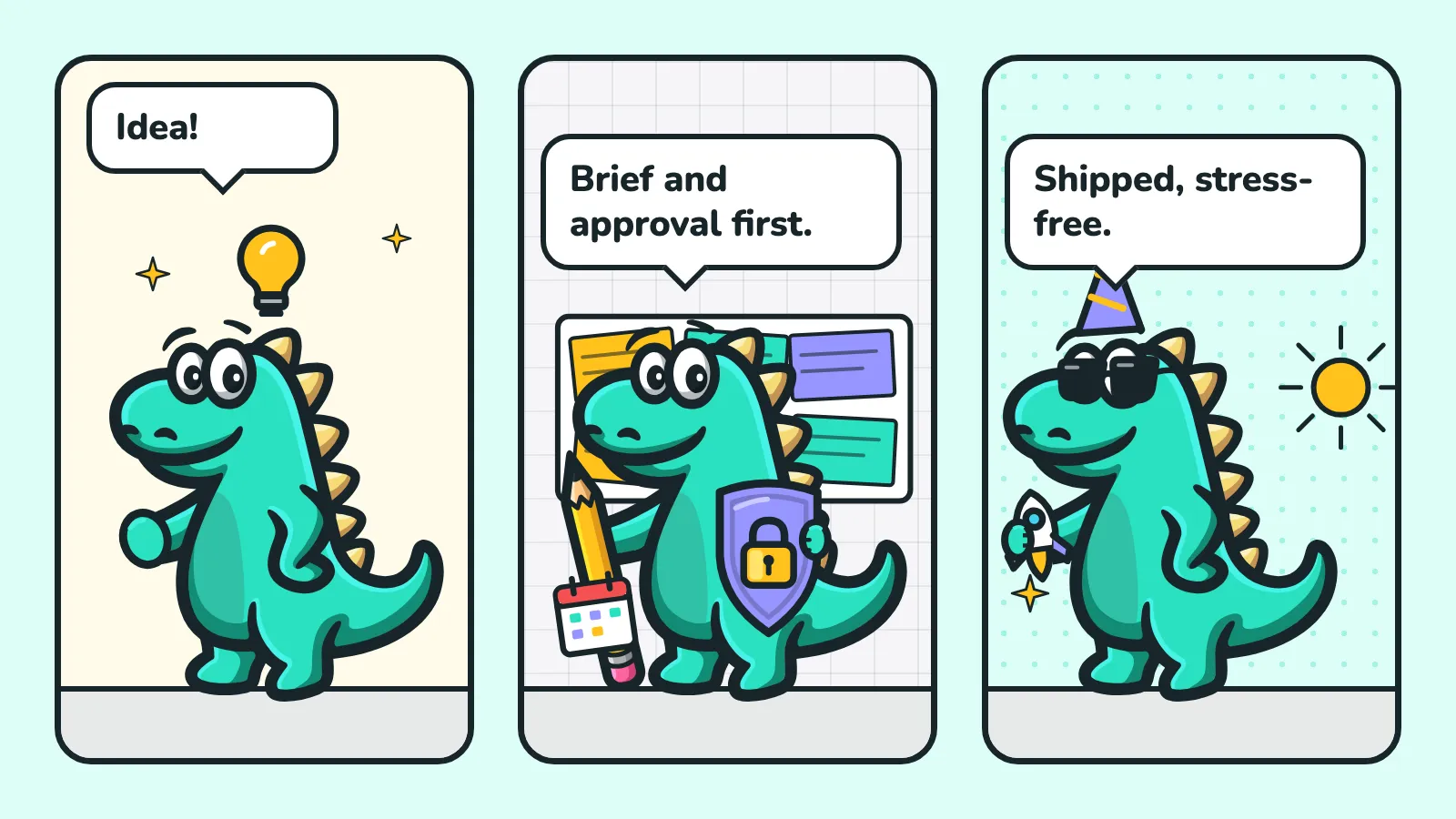
TL;DR
- A content creation process is the sequence of steps every piece of content goes through, from idea, brief, writing and approval to publishing and evaluation.
- A clear brief saves the most time, together with approvals in one place, where every task has its text and feedback attached.
- Decide what success looks like before you start. Set your metrics before you create and review them regularly.
What does a content creation process look like, from idea to reporting?
A content creation process is the sequence of steps every piece of content goes through, from idea to evaluation. Everyone works a bit differently, but the same steps kept coming up at the Chatter:
- Idea: associations, brainstorming, notes. Some people write by hand, others use an AI assistant as a sparring partner.
- Brief: who the content is for, what it should change and who works on it.
- Research: your audience and keywords, for example from a tool like Marketing Miner.
- Writing: the text gets written, rewritten, cut and left to rest.
- Approval: feedback on a specific text, attached to a specific task.
- Publishing and checking: how the content actually looks on the website or in the channel.
- Evaluation: what the content achieved and what that means for the next one.
No step is worth skipping. The ones that get dropped most often are the brief and the evaluation, which happen to be the 2 that tell you whether the content was worth it.
How do you find out what your audience wants?
Without knowing your audience, you’re writing into the void. Where to look for answers:
- The client or leadership: ask about goals, the target audience and the tone to use.
- Discussions: groups, forums, reviews and customer feedback.
- Customers: call them or send a short survey if the situation allows.
- Sales and product: they hear customer questions every day.
How to turn this into personas is covered in our article on target audiences.
Who does what, and what makes a good brief?
Where does the copywriter’s job end and the designer’s begin? You won’t find a sharp line. The brief decides: the more precise it is, the better the result.
On web projects, it pays off when the copywriter and designer work together from the start. In bigger companies, marketing, sales, product and UX all have a hand in the content. Nobody has to do everything, but people do have to talk to each other.
As a freelancer, it helps to have a few peers you can ask for advice and swap texts with. In a team, regular feedback and time to focus go a long way, for example 1 day a week just for writing, with no meetings.
Why let a text rest, and how do you approve it?
A text written in one go rarely holds up. Let it rest at least overnight, then read it the way your reader will. Mistakes, repetition and unnecessary paragraphs jump out right away.
Keep approvals in one place. What worked best for people at the Chatter was a project tool where every task has its text and feedback attached. Email threads with “final_v3_really_final” attachments lead straight to chaos.
In Contesaur, every piece of content moves through the workflow Idea → To Do → In Progress → In Review → Approved → Published, and you add feedback right to it. The whole team sees which stage it’s in and whose turn it is. More on the product page.
How do you balance timely and evergreen content?
React to trends, or plan ahead? You need both, in a sensible ratio and with an overview.
- Timely content: created fast, for special days or events. More in our article on reactive marketing.
- Evergreen content: blog posts and educational articles with a long shelf life. These need consistency, and at the Chatter 1 article a month came up as a sensible minimum.
How do you know what works?
Every channel has its own metrics:
- Blog: traffic and time on page.
- Website: how people move through it, where they leave and how many conversions the content brought.
- Newsletter: open rate, clicks and conversions, right in your email tool. Take open rates with a grain of salt, Apple Mail Privacy Protection has skewed them since 2021.
- Social media: reach, shares and comments.
Many people at the Chatter review their results once a month in a spreadsheet with conditional formatting. Green works, red doesn’t. For media monitoring, a tool like Mediaboard helps. Setting goals is usually the hardest part, so set them before you create, not when you report.
Example: the journey of one blog post
A small team is preparing an article on how to choose an accounting app:
- Idea: a salesperson reports that customers keep asking for a comparison of apps.
- Brief: the audience is freelancers and the goal is to get them to book a product demo. The copywriter writes, the designer prepares a comparison table.
- Writing and resting: the copywriter writes a first draft and tightens it the next day.
- Approval: a product specialist checks the facts, the marketing manager gives the final OK.
- Publishing: the copywriter checks the article on the website, on desktop and mobile.
- Evaluation: after a month, the team compares traffic and demo sign-ups with the goal from the brief.
Common mistakes
- No brief: everyone imagines a different result and the text gets rewritten again and again.
- Too many approvers: feedback contradicts itself and nobody has the final say.
- Publishing right after writing: mistakes slip through that anyone would spot the next day.
- Nobody evaluates: the team has no idea what works and keeps doing the same thing.
- Goals set at the end: the report just describes numbers and nothing follows from them.
Checklist
- Every piece of content has a brief with a goal, an audience and an owner
- I know who approves the content and who has the final say
- The text gets time to rest before approval
- After publishing, I check how the content looks in the channel
- Once a month, I review results against the goals
Wrap-up
Writing is just 1 of 7 steps. When content has a brief, one place for approvals and a goal set in advance, you don’t have to rewrite it over and over. Start with the brief and look at the numbers regularly. Then you work from a system, not on dinosaur instinct.
Marketing Chatter is a free online meetup held in Czech. See the upcoming dates.
FAQ
How long does it take to create one article?
It depends on the topic, length and how many people are involved in approval. Instead of guessing, time a few of your own articles and plan deadlines from that.
How many people should approve content?
As few as possible, ideally 1 person with the final say. Bring in subject experts early, while the content is being created, not at the very end.
Do I need a special tool for my content creation process?
A spreadsheet and shared documents are enough to start. A dedicated tool pays off once versions, feedback or deadlines start slipping through the cracks.
How do I get people outside marketing involved in content creation?
Give them a specific task with a deadline, like a 15-minute interview or a fact check. Leave the writing to marketing.