Target Audience and Personas: Who Are You Really Writing For?
You write blog posts, social posts and newsletters, but do you actually know who reads them? If not, you’re creating blind. At the tenth Marketing Chatter, we talked about how to get to know your target audience, why you should talk to customers and how to check that your content actually makes sense.
TL;DR
- A target audience is the broader group of companies and roles you create for, a persona is one specific model person within it, with their own needs, motivations and worries.
- Build personas from customer conversations, from people’s exact words and from what bothers them, not from your head.
- Jobs to be done and ongoing testing show whether your content solves what readers really need.
What’s the difference between a target audience and a persona?
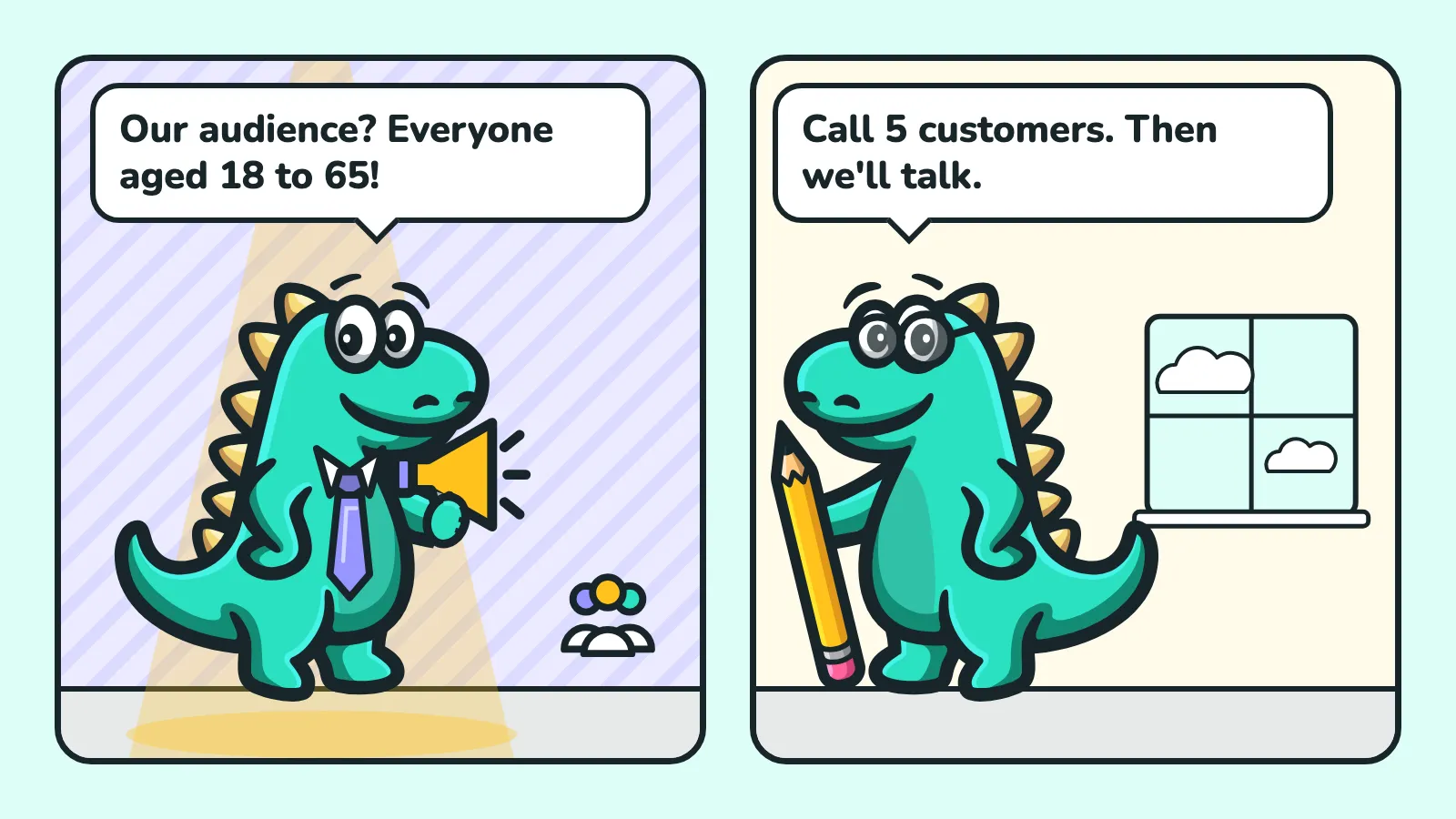
A target audience is a broad category, mostly the types of companies and the roles within them that you create for. A persona goes into more detail. It’s one specific model person with their own needs, motivations and obstacles.
Your content strategy needs both. You often know the target audience from the brief already. Personas you have to build yourself, and not out of thin air. We talked about how to do that at the tenth Marketing Chatter.
What should you ask before you start writing?
- Work: What does this person need to do their job?
- Pain points: What frustrations and obstacles do they face?
- Motivation: What drives them, both visibly and behind the scenes?
- Worries and expectations: What are they afraid of, and what do they expect from a solution?
- Expertise: Are they a pro in the topic, or a beginner?
When you know who reads your text, you can write it so it actually helps them.
Why talk to customers, and how?
Without real feedback, your content is built on assumptions. What helps:
- Phone calls: call them, let them talk and write down their exact words.
- Short surveys: a few questions people can answer in a couple of minutes.
- Facebook and LinkedIn groups: watch what people ask about and struggle with.
- Sales team: they know the most common questions and how customers feel.
Tip: Besides what people like, ask what bothers them. Negative emotions tend to be stronger and often say more about real needs.
How do you build a persona step by step?
- Demographics: age, job title, environment.
- Psychographics: what they deal with, how they decide, what they fear.
- A day in their life: where they spend time, what stresses them, what they look for.
- Jobs to be done: what they want to get done and why.
- User scenarios: what they do in a given situation, and what they need to hear to move forward. These scenarios connect naturally to the customer journey.
The jobs to be done approach was popularized by Clayton Christensen of Harvard Business School. In his view, people “hire” a product to do a specific job for them. There’s more on this in Know Your Customers’ “Jobs to Be Done” in Harvard Business Review. Jobs to be done often tells you more than demographics: 2 people of the same age and job title can be trying to get completely different jobs done.
Example persona:
- Who: a marketer at a 30-person B2B company, running marketing on her own.
- Pain point: content happens in bursts, whenever there’s time left.
- Worry: spending time on content nobody reads.
- Job to be done: having a content plan she can defend in front of leadership.
- What she needs to hear: that she can keep the plan going without a team.
How do you check that content works for your target audience?
- Analytics: time on page, bounce rate, clicks.
- A/B testing: different headlines, intros and formats.
- Asking directly: send the finished text to a few people from your audience and see how they react.
- Comments and feedback: do people comment on it, share it?
Silence is information too: if nobody responds, something may be off.
Where can you find data about your target audience?
- Customer interviews: the most valuable source.
- Facebook groups and comment sections: where people describe problems in their own words.
- Market research databases: in the Czech market, for example Atlas Čechů by Behavio, where you can explore groups of Czechs by behavior and attitudes for free.
- An AI assistant as a sparring partner: for hypotheses, not as a replacement for interviews.
Treat whatever AI suggests as a hypothesis to test with real people.
Where should personas live so the team actually uses them?
A persona in a drawer helps nobody. It only works if you have it in front of you while planning content. In Contesaur, your personas live in the Company section together with your brand and the See–Think–Do–Care stages. The AI marketing manager draws on them when suggesting content, and in the calendar you can filter what you’re creating for whom.
Common mistakes
- Personas from your head: created at a desk without a single customer conversation.
- Only positive questions: you learn what people like, but not what bothers them.
- An audience instead of a persona: “marketers at companies” is too broad to write for specifically.
- Personas in a drawer: the document exists, but nobody opens it while planning.
- No testing: content goes out and nobody checks whether it landed.
Wrap-up
Without knowing your target audience, you’re like a dinosaur in the fog. When you know who you’re writing for, you speak their language and answer the questions they actually have. Start by calling 5 customers and writing down their exact words.
Marketing Chatter is a free online meetup held in Czech. See the upcoming dates.
FAQ
How many personas do I need?
1–3 main personas are enough to start. With more, it’s hard for the team to keep them in mind while planning content, and the content gets diluted.
How often should personas be updated?
Whenever your product, market or customers change. Otherwise, review them at least once a year and add what you’ve learned from new conversations.
What’s the difference between a persona and an ICP?
An ICP (ideal customer profile) describes the ideal company as a customer: industry, size, situation. A persona describes a person inside that company: their job, motivations and worries.
Do personas make sense in B2B, where a whole company buys?
Yes. Several people are involved in a B2B purchase, such as the user, their manager and whoever pays, and each needs to hear something different. That’s why B2B teams create a persona for each role in the decision.